
GENERATION AI
RESOURCING SCHOOL LEADERS, EDUCATORS, AND PARENTS ON ALL THINGS RELATED TO ARTIFICIAL INTELLIGENCE, TEENS AND EDUCATION

“Eddie Cortés is a dynamic speaker!”
– Principal, O’Donnell Elementary School
Download Eddie’s Program Guide & Speaking Rate
✔ Top-Rated Youth Speaker for Students
✔ All-Inclusive Speaker Fee — No Travel Expenses
✔ The Best Speaker You’ve Ever Booked, or Your Money Back
ChatGPT Cognitive Decline: MIT Study on AI’s Brain Impact
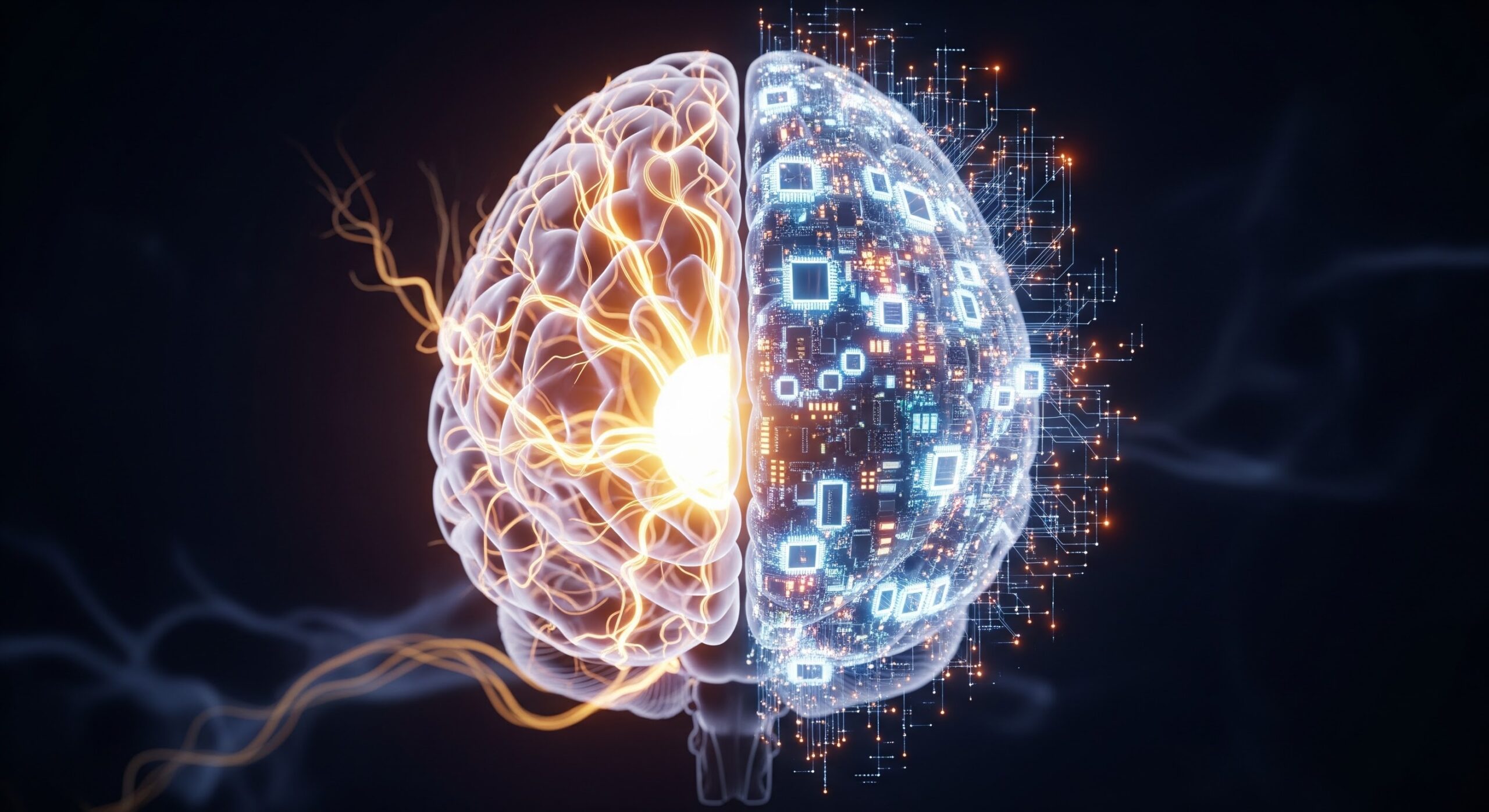
As a parent or educator, you’ve likely felt it: a nagging unease behind the undeniable convenience of AI. When a student uses a tool like ChatGPT for a tough homework assignment, are they finding a clever shortcut or short-circuiting their own learning? This question is at the heart of a major dilemma facing every school: the risk of ChatGPT cognitive decline. For years, this has been a subject of debate. But now, a groundbreaking MIT AI writing study is providing the first concrete, neurological evidence of what many have feared. The research on AI’s effect on student brains suggests that over-relying on AI for complex tasks like writing isn’t just changing the quality of student work—it’s measurably changing their brains, and the results are alarming.
The MIT Experiment: A Look at AI’s Impact on the Brain
In a four-month study, researchers from MIT equipped 54 college-aged students with EEG headsets to monitor their brainwave activity. They then divided the students into three groups and assigned them the task of writing several SAT-style essays :
- The “Brain-Only” Group: Wrote the essays with no technological assistance.
- The “Search Engine” Group: Could use Google for research.
- The “LLM” Group: Used ChatGPT to help them write.
The goal was to see, in real-time, how these different approaches affected the students’ cognitive engagement and critical thinking skills. The findings paint a stark picture of a brain on autopilot.
Finding 1: The Brain Switches Off
The most dramatic finding was the difference in neural activity. The EEG scans revealed that students using ChatGPT showed the weakest brain connectivity of all three groups. In fact, some metrics showed up to 55% lower cognitive engagement compared to the students who wrote without any tools. The researchers noted that “cognitive activity scaled down in relation to external tool use”. In simple terms, the more the AI did the work, the less the students’ brains did. This wasn’t just a momentary lapse; researchers observed that over time, cognitive function actually decreased in key areas of the brain for the ChatGPT group.
Finding 2: Memory Fades and Ownership Disappears
This reduced brain activity had a direct impact on learning and retention. When questioned about the essays they had just written, an astonishing 83% of the students in the ChatGPT group couldn’t recall key points from their own work. They struggled to provide accurate quotes or summarize their arguments because the information was processed so passively that it failed to be integrated into their memory networks. This directly answers the question: How does AI affect memory retention in students?
This led to what the researchers called a “fading sense of ownership over their work”. The essays felt less like their own creations and more like borrowed text, a feeling confirmed by the English teachers who assessed the AI-generated essays as largely “soulless” and lacking in original thought.
Finding 3: The Dangers of “Cognitive Debt”
Perhaps the most concerning discovery is what happened after the experiment. The ChatGPT cognitive decline measured in the AI-only group continued long after the study was completed. Even when they stopped using ChatGPT, participants still showed “sluggish brain activity”.
The researchers have a name for this phenomenon: “cognitive debt“. They speculate that when we repeatedly rely on external systems like AI, we replace the effortful cognitive processes required for independent thinking. We are, in effect, taking out a loan against our own brains. The short-term payment is convenience, but the long-term cost is a weakening of the very neural connections that build critical thinking, creativity, and resilience.
As the study’s authors state, “The use of LLMs [large language models] had a measurable impact on participants… the LLM group’s participants performed worse than their counterparts in the brain-only group at all levels: neural, linguistic and scoring”.
The Path Forward: From Autopilot to Co-Pilot
The “cognitive debt” identified by MIT is the direct result of students using AI on autopilot. It’s a passive approach that outsources thinking and, as the data shows, weakens the brain’s problem-solving muscles. But what if we could teach students a better way to avoid ChatGPT cognitive decline?
My AI school assembly program, Generation AI: Equipping Students for Safe, Wise, and Responsible AI Use, is designed to tackle this “lazy brain” epidemic head-on. We don’t just warn students about the risks; we give them a hands-on framework to use AI as a powerful co-pilot. This program directly addresses the findings of the MIT study by teaching students how to engage their brains first, using AI to enhance their own unique ideas, not replace them.
By giving your students, faculty, and parents a shared language for the responsible use of AI in schools, we transform a potential crutch into a tool for innovation. This assembly provides the foundational, school-wide strategy to ensure your students are building their minds, not outsourcing them.
Written by: Eddie Cortés
Sept. 15, 2025 © Eddie Cortés, LLC
Sources
Kosmyna, N., et al. (2025). “Your Brain on ChatGPT: Accumulation of Cognitive Debt when Using an AI Assistant for Essay Writing Task.” ArXiv.org.
Chow, A. (2025). “Is Using ChatGPT to Write Your Essay Bad for Your Brain? New MIT Study Explained.” Mashable.
Kosmyna, N., et al. (2025). “Your Brain on ChatGPT: Accumulation of Cognitive Debt when Using an AI Assistant for Essay Writing Task.” ResearchGate.
Kosmyna, N., et al. (2025). “This is your brain on ChatGPT: lower neural interconnectivity and ‘soulless’ work.” IFLScience.
Ingenius Prep. (2025). “Your Brain on ChatGPT: What MIT’s Research Means for College Essays.” Ingenius Prep.
Illinois College of Education. (2024). “AI in Schools: Pros and Cons.” University of Illinois.
Kosmyna, N., et al. (2025). “Your Brain on ChatGPT: Accumulation of Cognitive Debt when Using an AI Assistant for Essay Writing Task — MIT Media Lab.” MIT Media Lab.
Kosmyna, N. (2025). “Your Brain on ChatGPT: Everything Educators Need to Know About MIT’s AI Study.” Tech & Learning.
Chow, A. (2025). “ChatGPT May Be Eroding Critical Thinking Skills, According to a New MIT Study.” TIME.
Council, S. (2025). “New MIT study suggests that too much AI use could increase cognitive decline.” Nextgov/FCW.
Council, S. (2025). “New MIT study suggests that too much AI use could increase cognitive decline.” Nextgov/FCW.
Chow, A. (2025). “ChatGPT May Be Eroding Critical Thinking Skills, According to a New MIT Study.” TIME.
Digital Watch Observatory. (2025). “MIT study links AI chatbot use to reduced brain activity and learning.” Digital Watch Observatory.
Illinois College of Education. (2024). “AI in Schools: Pros and Cons.” University of Illinois.
GENERATION AI
SCHOOL ASSEMBLY PROGRAM
ABOUT GENERATION AI SCHOOL ASSEMBLY PROGRAM
Equipping Students for Safe, Wise, and Responsible AI Use with Motivational Youth Speaker Eddie Cortés
Students today are growing up in the first generation where artificial intelligence is a part of daily life.
AI can spark creativity and learning, but it also introduces new risks to student well-being, from cyberbullying amplified by deepfakes to the erosion of critical thinking.
In this session, students experience interactive segments like a real-time deepfake reveal and a “human vs. AI” creative challenge that make the abstract dangers of misinformation and digital dependence concrete and memorable. The program empowers students to use AI wisely, not as a crutch, while reinforcing digital citizenship, mental health, and future-ready learners.
If you’re looking for a speaker who combines authenticity, impact, and energy to tackle the most relevant topic in education today, Eddie Cortés delivers.
Call (800) 799-1460 between 8 AM-5 PM CT from Monday-Friday to schedule a quick chat with Top Youth Speakers.

EDDIE CORTÉS
Youth Motivational Speaker on Responsible AI Use
ABOUT AI SCHOOL ASSEMBLY SPEAKER EDDIE CORTÉS
Eddie Cortés is a former at-risk student turned national youth speaker who helps students build resilience and rewrite the way they see themselves. Today, he’s a leading voice on the most critical challenge facing this generation: navigating the world of Artificial Intelligence. Eddie believes the inner battles students have always faced—mental health, self-doubt, and belonging—are now amplified by technology, making the responsible use of AI the new frontier for student leadership and well-being.
To learn more about Top Youth Speaker Eddie Cortés click here.
Follow Eddie Cortés on social: Instagram | Facebook | Linked In
© 2020 Emerging Students | PRIVACY POLICY